
UK DIY News
Linnworks Report Highlights Hidden Cost of Peak Season Shipping for Retailers
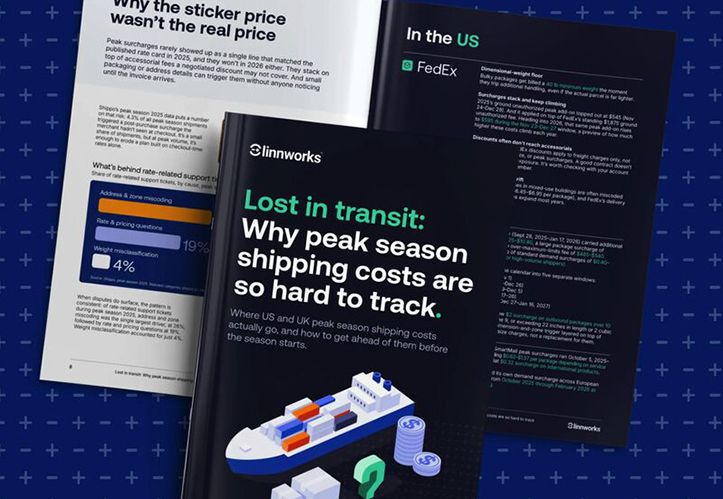
New analysis of almost 70 million consignments reveals how surcharges, parcel dimensions and international fulfilment can significantly increase retailers’ actual delivery costs.
New research from Linnworks has highlighted the growing complexity of shipping costs for retailers, warning that headline carrier rates can provide a misleading picture of the true cost of fulfilment during peak trading periods.
The new report, Lost in transit: Why peak season shipping costs are so hard to track, analyses Linnworks transactional shipping data from the 2025 peak season across the UK and US, alongside benchmark data supplied by shipping platform Shippo.
The Linnworks dataset covers almost 70 million consignments, including 68.9 million from 1,671 UK-based sellers, and examines how weight, distance, carrier choice and additional surcharges affected the final cost of shipping.
Headline shipping rates tell only part of the story
One of the report's central findings is the difference between the shipping cost retailers expect when an order is processed and the amount ultimately charged.
According to Shippo's peak season data, 4.3% of shipments triggered a post-purchase surcharge that the merchant had not seen at checkout. While that percentage may appear relatively small, Linnworks argues that at peak-season volumes these unexpected charges can materially undermine fulfilment budgets and margins.
Address and zone miscoding accounted for 26% of rate-related support tickets during the period, compared with 19% for rate and pricing queries and just 4% for weight misclassification.
The findings are particularly relevant as retailers prepare for peak 2026, with Linnworks noting that many of the same surcharge mechanisms are returning and, in several cases, at higher rates.
Small parcels can create surprisingly large costs
The research also challenges the assumption that unusually heavy shipments are necessarily the biggest source of additional cost.
In the UK, Linnworks found a pronounced U-shaped relationship between parcel weight and cost. Lightweight parcels attracted disproportionate minimum charges, shipments between 1kg and 20kg represented the most efficient range, while parcels weighing more than 20kg cost nearly 17 times the mid-weight rate.
This could be particularly significant for Home Improvement and Garden retailers, where product ranges frequently combine small accessories and consumables with long, bulky, heavy or awkward-to-ship products.
International fulfilment dramatically increases the exposure
The difference between domestic and international fulfilment was even more pronounced.
Among US sellers using FedEx, cross-border shipments cost approximately 10.9 times more per consignment than domestic shipments. Within Linnworks' UK cohort, international Royal Mail parcels cost approximately 20.9 times more than domestic consignments.
Interestingly, the underlying average domestic cost of the two carriers was very similar when converted into the same currency. Linnworks found an average FedEx US cost of $3.08 per consignment compared with approximately $3.05 for Royal Mail in the UK.
The significant difference therefore emerged from what was layered on top, particularly the surcharge structure and the domestic versus international shipping mix.
Carrier selection becomes an operational decision
Rather than simply negotiating a preferred carrier and applying that relationship across the majority of orders, Linnworks argues that retailers increasingly need to make carrier selection at individual order level.
Its data found that only 1.5% of merchants shipping during both pre-peak and peak periods in 2025 changed their primary carrier during the season. Instead, Linnworks recommends comparing available rates for individual orders according to factors including weight, dimensions and destination.
Multi-carrier rate-shopping increased from around 6–7% before peak to 8% during peak season 2025, suggesting that adoption remains relatively limited despite the potential savings available.
The report recommends applying automation at three points in the fulfilment process: inventory allocation, carrier selection and before label printing. It also advises retailers to review packaging and dimensions before orders cross carrier surcharge thresholds and to revisit carrier contracts before peak-season pricing takes effect.
For retailers operating increasingly complex ecommerce, marketplace and drop-ship models, the findings reinforce the importance of understanding the true cost-to-serve, rather than focusing solely on the headline delivery rate.
The conclusion from Linnworks is that peak-season shipping costs are not necessarily unpredictable. The same weights, destinations and dates that affected retailer margins during 2025 are returning in 2026, with some charges already confirmed at higher levels.
The competitive advantage, therefore, may increasingly lie not simply in securing cheaper shipping, but in having sufficient data and automation to make the right fulfilment decision for every order before it leaves the warehouse.
Source : Linnworks
Image : Linnworks

Insight provides a host of information I need on many of our company’s largest customers. I use this information regularly with my team, both at a local level as well as with our other international operations. It’s extremely useful when sharing market intelligence information with our corporate office.


Don't miss out on all the latest, breaking news from the DIY industry