
UK DIY News
Consumer Sentiment Rises to its Highest Level in Five Years

- PwC’s consumer sentiment score rises from –13 in April to +1 in the latest survey
- Confidence rises across all age groups
- Household finances at their strongest in four years, helped by higher wages and lower inflation
- One in seven (14%) had already started Christmas shopping in mid-August
- One in four say they’ll spend more on Christmas shopping and celebrations this year, while only 21% say they will spend less
PwC's latest Consumer Sentiment Survey reveals that improving household finances and lower inflation expectations saw consumer confidence rebound and reach its highest in five years.
The survey, a barometer of consumers’ spending intentions, recorded an index score of +1 in August, after a sharp fall in April to –13 as fears over the cost-of-living gripped consumers as conflict continued in the Middle East. Now, after the hottest UK summer on record, the index score has reversed that decline and is now two points higher than in January, continuing the upward trend since the start of last year.
Sentiment saw an increase across all age groups, with 35 to 44-year-olds in particular seeing their sentiment reach its highest ever recorded level of +21. Sentiment among over 65s also rebounded to its highest level since the removal of winter fuel allowance was announced in autumn 2024, overtaking both the 54 to 65 and 45 to 54 age groups.
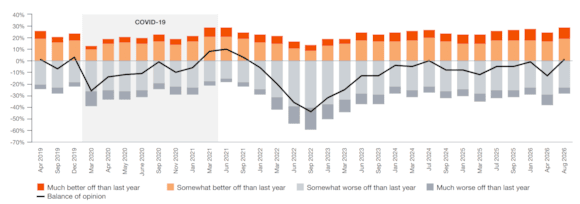
The findings show perceived household finances are at the strongest they have been in the last four years, improving across every demographic. Almost two in five (39%) of those surveyed describing their financial situation as 'healthy' – i.e. that they have money left over at the end of the month for luxuries or savings - up from 27% in September 2022. At the other end of the spectrum, among the least affluent ‘E2’ socioeconomic group, the proportion of those either struggling to pay bills or having missed bill payments altogether has fallen from 28% to 12% over the same period.
This combined with a period of real earnings growth, falling food inflation, and lower consumer inflation expectations have contributed to consumers feeling more buoyant.
The findings also show that fewer consumers plan to make short-term spending cutbacks than in the spring. Just over two-thirds (68%) plan to make some kind of spending cutback in the next three months, compared with almost four in five (78%) in April.
Confidence may be short lived
However, the growth in confidence is still tempered by worries about the cost of living, with 85% of consumers citing this as one of their top concerns alongside the UK economy (86%). While both figures are down from April, they are roughly at the same level as they were at start of the year. Consumers’ levels of concern are largely unchanged from January, with the environment and global warming being the only issue to become more pressing – 75% of consumers cite this as a concern, up from 71% at the start of the year, in the wake of recent heatwaves.
Concerns amongst different demographic groups show a more nuanced picture. For young people, 61% of 18 to 24 year-olds say they're worried about job prospects or job security, up from 54% in January. Amongst those aged 25 to 34, concerns around mortgage repayments or rent increases rose from 52% to 62% over the same period.
Sam Waller, Leader of Industry for Consumer Markets at PwC UK, said:
"The World Cup and the heatwave have helped spur a welcome uplift in consumer sentiment. But our survey shows consumer caution hasn't gone away. Cost of living pressures remain – and for some are an increasing concern.
"As we head into autumn, the pressure on household finances will increase as energy and food prices rise. This will impact consumer facing businesses – along with wider macroeconomic headwinds that could spell higher interest rates and possible tax rises. Businesses should incentivise customers to start Christmas shopping now, and at the same, they must prepare themselves for a slowdown in consumer demand, look for ways to optimise operating costs, and to get their back-of-house in order."
Christmas comes early
At the time of the survey in mid-August, 14% of consumers polled said that they had already started their Christmas shopping. A further 16% said that they planned to do most of their Christmas shopping earlier than usual, even though they had not started yet, compared with only 4% saying they would make most of their festive purchases later.
Meanwhile, for the first time since the end of the pandemic, more consumers said that they expected to spend more this year on Christmas shopping and celebrations rather than less. Some 25% thought they would spend more in the run up to this Christmas - up from 22% a year ago - compared with only 21% expecting to spend less – down from 26% in September 2025. For those intending to spend more this year, the top reason was that it is ‘important to keep Christmas special' (cited by 33%), while 32% said it was because they had saved up throughout the year. For those who plan to spend less on Christmas this year, the rising cost of living (73%) was their number one reason.
Jacqueline Windsor, Head of Retail at PwC UK, said:
"For retailers, Christmas needs to come early. Consumer sentiment has hit positive territory for the first time since the pandemic, and some people have already started festive shopping. It's a golden period of consumer confidence that may have come too early for the Golden Quarter. We expect food and fuel inflation to bite in the Autumn, and added uncertainty as the new Chancellor assesses if any tax changes may be needed in the upcoming Budget. Retailers would do well to strike early with Christmas before purse strings tighten."
Source: PWC and Insight DIY News Team




Insight DIY always publishes the latest news stories before anyone else and we find it to be an invaluable source of customer and market information.


Don't miss out on all the latest, breaking news from the DIY industry